
India’s 5G revolution is transforming the digital landscape — promising ultra-fast speeds, low latency, and high data capacity. Yet, the real backbone of this revolution lies underground — in the fiber optic networks that connect every 5G tower, data center, and smart device.
As telecom operators expand high-speed 5G coverage across the country, fusion splicing machines are playing a crucial role in ensuring strong, seamless, and lossless fiber connections that can handle the data demands of next-generation networks.
Why Fusion Splicing Machines Are Essential for 5G
1. Foundation for 5G Networks: Unlike 4G, 5G requires dense fiber optic networks and small cells to handle high bandwidth and real-time communication. Fiber optic cables offer ultra-low latency, high data capacity, and long-distance reliability, making them the essential backbone for 5G. Fusion splicing ensures seamless fiber connections for maximum efficiency.
2. Backbone for Telecom Expansion: Leading telecom operators such as Reliance Jio, Bharti Airtel, and BSNL rely heavily on fusion splicing technology for long-haul and metro fiber routes. These high-precision splices form the core backhaul infrastructure that powers nationwide 5G networks. Field engineers trust machines like the Star FFS 9000 Fusion Splicer and Fujikura 88S+ for their core alignment accuracy, durability, and portability.

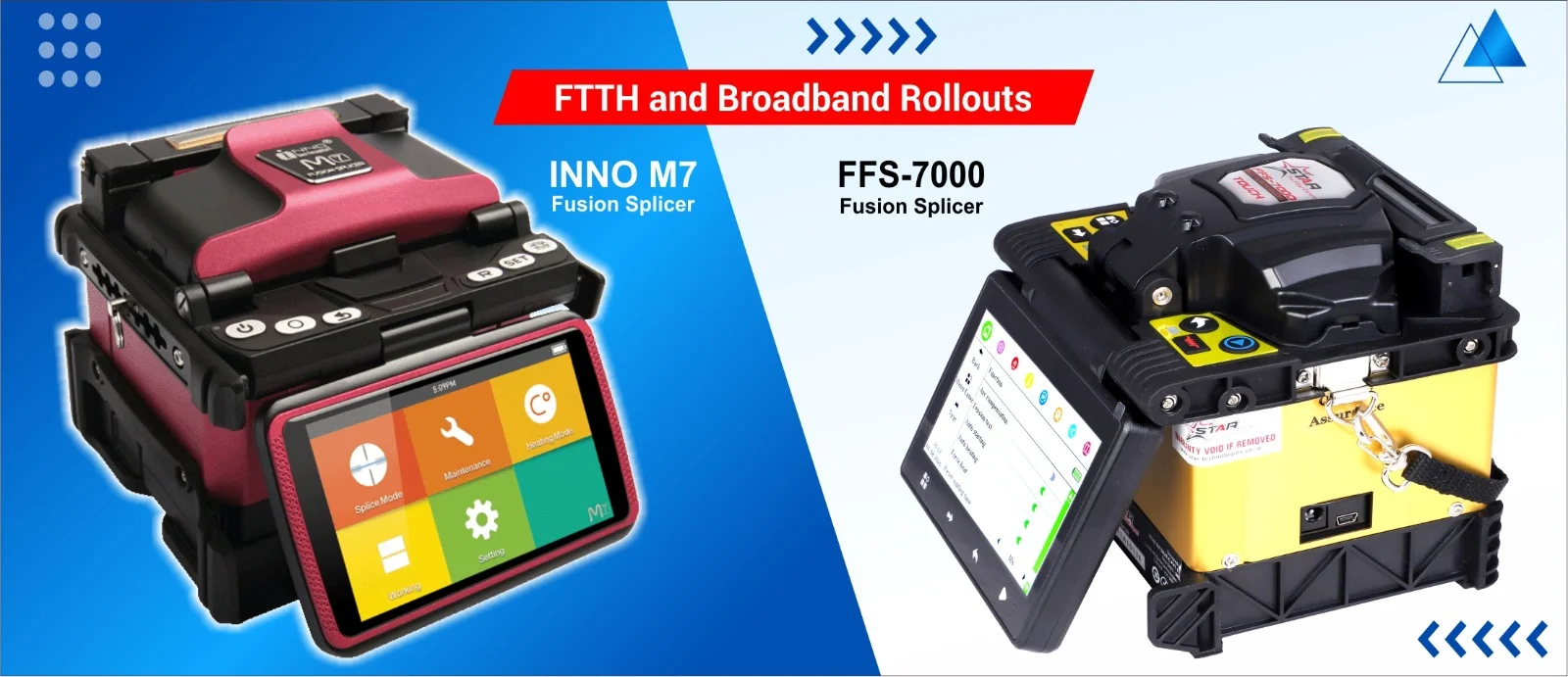
3. FTTH and Broadband Rollouts: The rise in FTTH (Fiber-to-the-Home) and IoT-based applications requires massive fiber installations across residential and business networks. Compact and high-speed splicers such as the Star FFS 7000 and INNO M7 Fusion Splicer are helping technicians complete drop fiber connections with efficiency and precision — ensuring high-speed, stable connectivity to homes and enterprises.
4. Smart Cities and Data Centers: In smart cities, industrial automation zones, and hyperscale data centers, fusion splicing is the cornerstone of network reliability. Machines like the Star FFS 12000 Ribbon Fusion Splicer and Sumitomo T-72C+ enable multi-core splicing, ensuring robust, low-loss connections essential for real-time applications, 5G base stations, and AI-driven systems.

Advanced Features Powering India’s 5G Fiber Network
Modern fusion splicing machines for telecom and FTTH come with cutting-edge technologies designed to accelerate field deployment:
- Core Alignment Technology: Ensures maximum accuracy with minimal insertion loss.
- Auto Arc Calibration: Adapts to varying environmental and fiber conditions automatically.
- High-Speed Splicing & Heating: Reduces installation time for large projects.
- Rugged, Portable Design: Built to withstand dust, heat, and vibration — ideal for Indian field environments.
- Smart Data Logging: Stores splice records for quality control and project documentation.
India’s Growing Fiber Demand
- Growing Demand: According to TRAI and DoT reports, India requires over 3 million km of new fiber by 2026 to meet 5G and FTTH demands.
- Indispensable Tool: Fusion splicing machines are an indispensable tool for telecom providers, network integrators, and government projects like BharatNet.
- Digital Future: Fusion splicing machines are essential for building the country’s high-speed fiber backbone, enabling India’s digital-first, 5G-enabled future.
Conclusion
As India accelerates toward a 5G-powered digital era, fusion splicing machines remain the unsung heroes of its fiber expansion journey.
With cutting-edge precision, automation, and rugged design, Star’s fusion splicers and fiber testing tools ensure every fiber connection delivers maximum speed, minimum loss, and unmatched reliability. Whether you’re building a 5G network, expanding FTTH coverage, or maintaining telecom backhaul — investing in a high-quality fusion splicing machine is key to powering India’s connected future.

 Request Call Back
 WhatsApp us